Available Methods


(A)  Inductively Coupled Plasma Mass Spectrometry (ICP-MS)


ICP-MS is a method used to quantify most elements in the periodic table. It uses argon plasma to form ions from samples. The ions are then analysed with mass spectrometry.

Pros: Requires very small amount of sample
Cons: Certain elements cannot be analysed

(B)  High Performance Liquid Chromatography (HPLC)


HPLC is a chromatographic method which is able to be used to quantitate the concentration of p-phenylenediamine in samples.

Pros: Does not require much pre-treatment for sample, accurate injection even with manual injection with Rheodyne loop injector
Cons: Samples have to be fully dissolved in aqueous solvents


(C) Gas Chromatography Mass Spectrometry(GC-MS)
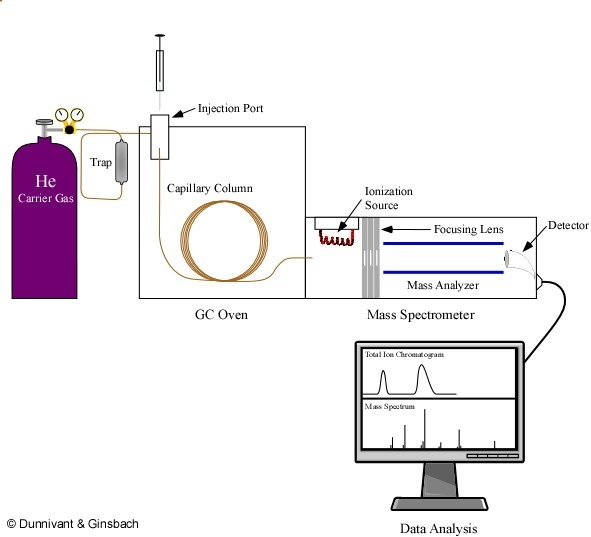
GC-MS is another viable chromatographic method able to quantitate the concentration of p-phenylenediamine. It uses a gaseous mobile phase.

Pros: Able to quantitate from peak area of retention time
Cons: Low-volatility samples require chemical derivatization

Selected method for analysis:

HPLC is selected for analysis as it does not require laborious sample preparation such as chemical derivatization. HPLC is also less expensive compared to the other methods. It also has fast analysis time. Henna is readily available in liquid form for dissolving. Reverse-HPLC can be used for the analysis of PPD since PPD is non-polar. On the other hand, ICP-MS is used to determine the metal components of the dye which is not the main purpose of our analysis.


Materials & Methods:

HPLC conditions: 
Brand: Agilent 1100 HPLC Series
Column: 250mm x 4.6mm i.d; stationary phase, LiChrospher RP-18, 5μm
Mobile Phase: flow rate 1.5ml/min, 0.05 M acetic acid-methanol (95/5)
Refractive Index Detector (RID) at 290nm 


Samples
Twenty five henna samples were bought at 15 henna salons located at three different cities in the United Arab Emirates. Among the 25 henna samples, there were 11 black  and 14 red henna.

Preparation of PPD standard (0.11mg/ml)
Weigh 0.011g of pure PPD standard and dissolve it in 50% aqueous methanol solution.

Preparation of samples
Weigh 1.0g of collected henna samples and dilute it with 50% aqueous methanol solution to the brim in a 50ml volumetric flask. This solution will be filtered after 15 minutes. Transfer 1ml of the filtered solution and dilute it to 5ml with 50% aqueous methanol solution. The PPD solution can now be analysed.

Dilute 1ml of the standard solution to 5ml with 50% aqueous methanol solution and analyse the spectrum and retention time. This method is use to confirm the identity of PPD in the samples.

Risk Assessment


1. Hazard Identification
2. Risk Evaluation & Control
SN
Task
Hazards
Possible Consequences
Existing Recent Control (if any)
S
L
R
Additional / New Risk Control
S
L
R
Risk Evaluation
1
Handling of PPD
Carcinogenic
Severe over-exposure could cause death
Regular lab precautions to be taken
5
3
15
Keep in a cool, well-ventilated place
3
1
3
Medium
2
Handling of methanol
Flammable
Could cause serious burns if substance gets inflamed
Place it away from any source of fire as much as possible
3
2
6
Handle under fume hood
2
2
4
Low
3
Handling of henna
Possible skin allergen
Tight feeling in chest, sneezes, runny nose, coughs and itchy eyes
Gloves to be worn at all times
1
1
1
-
1
1
1
Low
4
Handling of HPLC
Standard handling of electronics
Electric shock, if not handled properly
Ensure hands and gloves are dry before using
1
1
1
-
1
1
1
Low

Results & Discussion


Qualitative Analysis
The retention time of the standard and sample solution was used for qualitative analysis. It was found that the retention time of the standard was 4.565 minutes. As for sample 1 to 10 (picture above), the retention time falls between 4.413 and 4.686 minutes. The spectrum of the samples is also similar to the spectrum of the standard. 
Quantitative Analysis
The concentration of the samples was read off directly from the instrument and organised in table 1. Table 1 shows concentration of PPD in the samples of the respective salons. It tells us that PPD is found in all black henna samples and the concentration ranges between 0.38% and 29.5%. However, there were no signs or low levels of PPD detected for the red henna samples. The concentration of PPD in the red henna samples ranges between 0.005% and 0.23& which is very low. Therefore, HPLC is useful in determining PPD in samples qualitatively and quantitatively. In comparison, the black henna has higher concentration of PPD than red henna. This is proven by the dark colour which indicates the presence of high concentration of PPD.

Conclusion


In conclusion, the black henna samples bought from the respective henna salons contain high concentration of PPD and thus, increases the risk of becoming sensitive to black henna.  The concentration of PPD in some of the samples are higher than the permitted concentration of PPD in hair dye products. This is also supported by hospitals which state that the use of PPD in black henna results in adverse health effects on the health of humans. Therefore, PPD should NOT be used in henna or hair dye to prevent detrimental health effects.

References

Determination of para-Phenylenediamine (PPD) in Henna in the United Arab Emirates. [ONLINE] Available at:http://www.ncbi.nlm.nih.gov/pmc/articles/PMC2872353/. [Accessed 23 January 2014]

[ONLINE] Available at:http://www.webapps.cee.vt.edu/ewr/environmental/teach/smprimer/icpms/schematic.gif. [Accessed 01 February 2014].

 [ONLINE] Available at:http://pioneer.netserv.chula.ac.th/~skitipat/hplc/pic1.gif. [Accessed 02 February 2014].

[ONLINE] Available at:http://people.whitman.edu/~dunnivfm/C_MS_Ebook/CH2/Figures/Fig_2_5_GC-MS.jpg. [Accessed 01 February 2014].

[ONLINE] Available at:https://www2.essex.ac.uk/estates/Documents/Risk%20assessment_preferred%20template.pdf. [Accessed 04 February 2014].